
Starting from 1 January 2023, the collection of data for reporting of the annual operational Carbon Intensity Indicator (CII) and corresponding CII rating becomes mandatory. The amendments to MARPOL Annex VI entered into force on 1 November 2022, and were developed as part of the IMO Strategy on Reduction of GHG Emissions from Ships, agreed upon in 2018.
Which ships do the CII regulations apply to?
The CII regulation laid out in MARPOL Annex VI (Regulation 28) applies to all ships of 5,000 gross tonnage (GT) and above, which is similar to the ships subject to Regulation 27 on fuel consumption reporting to the IMO Data Collection System (IMO DCS). You can read more about IMO DCS requirements in our previous article — Monitoring emissions.
What is so special about this regulation?
CII is not the only regulation coming into force this year. Simultaneously with CII, from 1 January 2023, the Energy Efficiency Existing Ship Index (EEXI) regulation comes into force, but there are significant differences between these two measures. While EEXI is a once-in-a-lifetime certification, the CII regulation is an operational measure and CII is calculated annually based on the ship's performance.
How is attained CII in a given year calculated?

How is the CII reference value calculated?

How is the required CII calculated?

Finally, how are the scores assigned to the attained CII?

How does it all come together, and how is the grade determined?
What is considered noncompliance?
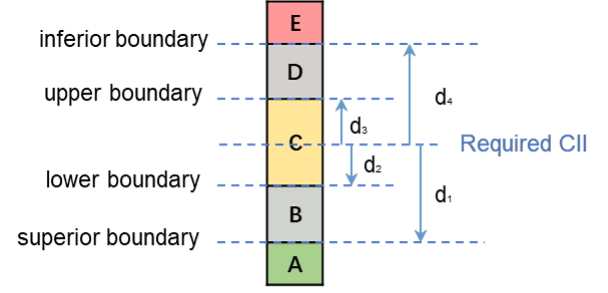
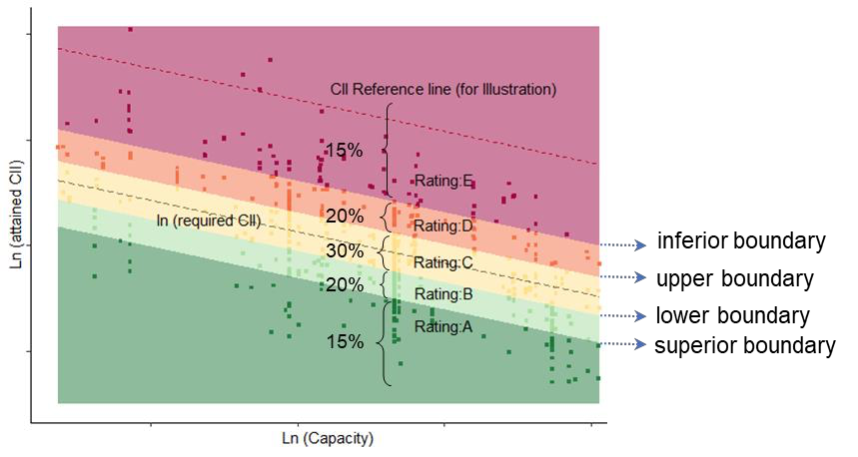
As can be seen above from the calculations and the graphical representation, the ship's carbon intensity is rated A, B, C, D, or E — major superior, minor superior, moderate, minor inferior and inferior respectively. With this grading, there are two types of non-compliance. A ship is considered non-compliant if it scores E for one year, and it is considered non-compliant if the vessel scores D for three consecutive years.
What are the consequences of noncompliance?
If a vessel is noncompliant in any of the two noncompliance regimes mentioned above, then the ship will have to submit a corrective action plan that shows how the required grade C will be achieved. This plan will become a part of the Ship Energy Efficiency Management Plan (SEEMP), which needs to be verified.
Important points to consider
The required annual operational CII is not a fixed variable. Every year the required CII for a ship becomes more stringent based on the reduction factors. For now, the reduction factors are known for years up to 2026, while the new reduction factors will be announced after the review in 2026.
Shipowners have to be cautious with the achieved grades since the rating is based on annual operations. Therefore, the margins between compliance and noncompliance can be very small in many cases. Even a few per cent changes in operational efficiency can lead to different grading, and that, combined with the annual reduction factors, can cause issues for some ships.
There are correction factors and voyage adjustments that may be applied in calculating the attained CII. This information is covered in the IMO 2022 Interim Guidelines on Correction Factors and Voyage Adjustments for CII Calculations (CII Guidelines, G5).
It can be said that the introduction of new statutory requirements is always a challenge for shipowners. With the CII regulation coming into force this year, the shipping industry is one step closer to meeting its decarbonization ambitions. CII scores and rating calculations are now clear, especially since it is based on the already existing IMO DCS, but some questions do arise. Does this regulation make sense? Will it really help to achieve the laid-out IMO ambitions? Is it fair? How will it impact the industry? These are just some of the questions that lay a gloomy outlook on the regulation itself. In the next articles we at Nortech AI would like to discuss and address some of these concerns, so tune in!
Sources
- DNV
- Resolution MEPC.328(76) — Amendments to the Annex of the Protocol of 1997 to amend the International Convention for the Prevention of Pollution from Ships, 1973, as modified by the Protocol of 1978 relating thereto (2021 Revised MARPOL Annex VI)
- 2022 Guidelines on Operational Carbon Intensity Indicators and the Calculation Methods (CII Guidelines, G1)
- 2022 Guidelines on the Reference Lines for use with Operational Carbon Intensity Indicators (CII Reference Lines Guidelines, G2)
- 2021 Guidelines on the Operational Carbon Intensity Reduction Factors relative to Reference Lines (CII Reduction Factors Guidelines, G3)
- 2022 Guidelines on the Operational Carbon Intensity Rating of Ships (CII Rating Guidelines, G4)
- 2022 Interim Guidelines on Correction Factors and Voyage Adjustments for CII Calculations (CII Guidelines, G5)