Starting from 1 January 2023, the collection of data for reporting the annual operational Carbon Intensity Indicator (CII) and corresponding CII rating becomes mandatory. Here at Nortech AI, we have examined the details of the calculations behind the CII requirements in our previous post, and have looked at the flaws in the new regulation. Notwithstanding, this regulation is here to stay and the industry must comply with it — so the question arises of how that can be accomplished.
IMO suggested solutions
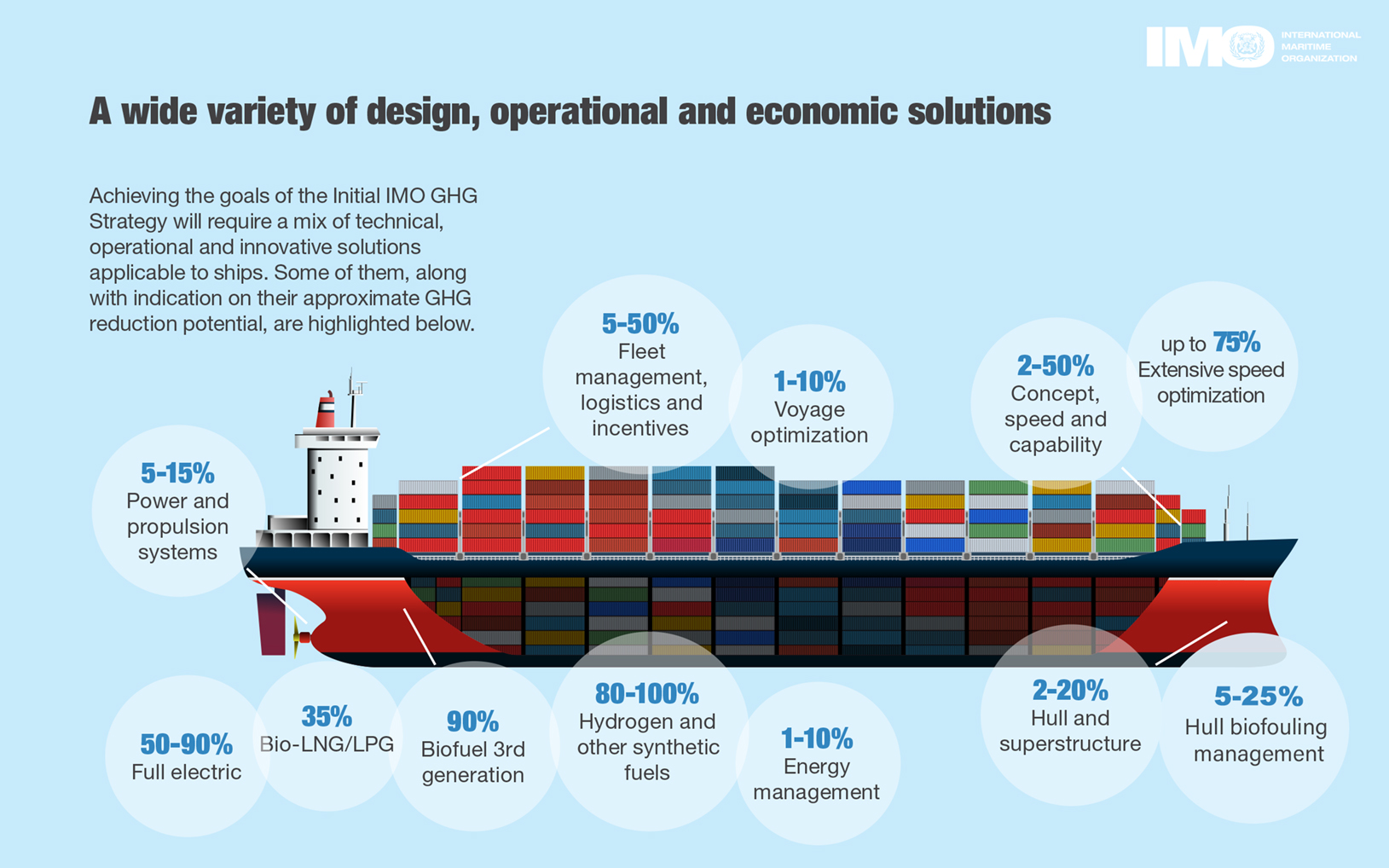
The International Maritime Organization (IMO), together with introducing the new measures, has indicated possible measures for increasing efficiency. Low-carbon and alternative fuels to achieve higher ratings are one of the first suggestions, but the question is the feasibility of such solutions. IMO also covers operational and design aspects that shipowners can pursue, such as hull cleaning, speed/routing optimization, and solar/wind auxiliary power solutions. It might seem odd that shipowners are being suggested to install low-energy light bulbs among the top solutions, but who are we to judge…
The solutions can be grouped into voyage and speed optimization, alternative/low-carbon fuels, hull performance optimization, and engine/power optimization. In the following sections, we will focus mostly on the latter solutions.
Alternative fuels — the largest bet of the decade?
In the last year, large players in the shipping industry have been placing their bets on the fuels of the future. Hoegh Autoliners, together with MAN, K Line, and other large companies, are deciding on ammonia as the future fuel in their newbuilding programs. Companies like Pacific Basin and others are choosing methanol as the go-to alternative fuel for their newbuildings. Even charterers like Vale have placed their bet on methanol in their latest call for contract bids. Conversely, there are many companies that are choosing LNG as the transition fuel to decrease their carbon footprint.
But why are we looking at the choice of alternative fuels as a bet? Well, this choice comes with significant uncertainty in regard to the infrastructure and designs. In any case of alternative fuels, additional infrastructure needs to be in place before large investments are made in one direction or the other. But then again, different shipowners are choosing different alternative fuels, so the feasibility is in question again. All these alternative fuel projects are also adding significant costs to newbuilding projects, and these designs are still seen as "new".
Accessibility? What is the common feature of the companies that are placing these future fuel bets? It is the fact that these are large players. What are the largest barriers for small to medium-sized shipping companies (SMEs)? It is the complexity of such projects and the additional capital requirement. These factors are essential for SMEs to take advantage of alternative fuels, so the industry still needs to undergo a significant standardization process to make these solutions more accessible.
Alternative fuels and emissions
The "greenness" of a fuel depends on the type of emission accounting. Generally speaking, there are three types of emission accounting: WTT, TTW, and WTW. Tank-to-Wake (TTW), in the case of shipping, accounts for all of the emissions from the combustion process on a ship. Well-to-Tank (WTT) is emissions resulting from upstream activities, including the production of the fuel itself. Well-to-Wake (WTW) accounts for both TTW and WTT combined.
In 2021, an article on "Reduction of maritime GHG emissions and the potential role of E-fuels" was published by Lindstad et al., where WTW emissions were also discussed in detail (Fig. 2).
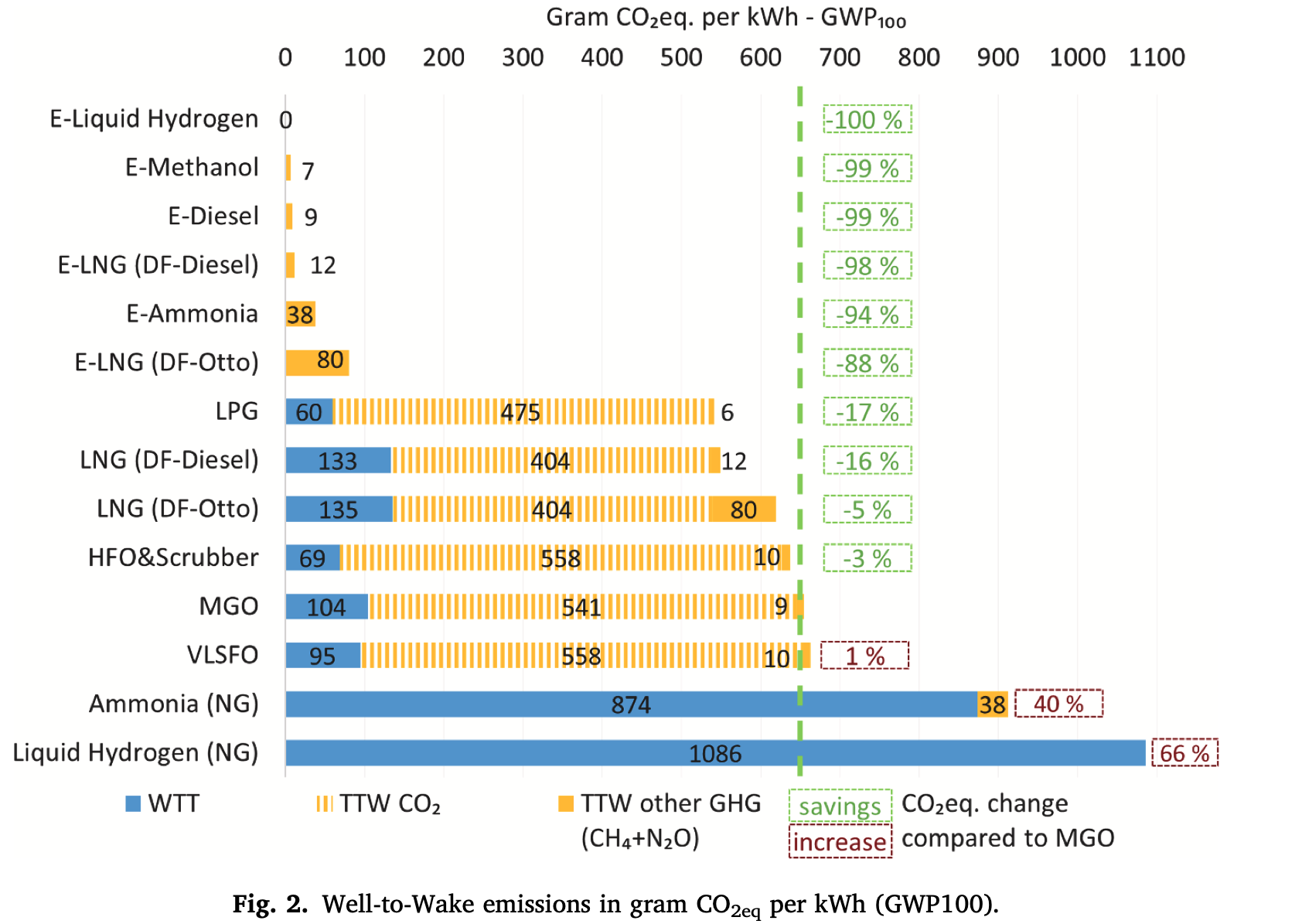
In this figure we can clearly see that significant emission reductions can be achieved only with E-fuels (fuels produced with renewable energy — green fuels). In the case of conventionally produced ammonia and hydrogen, the WTW emissions are 40–66% higher than MGO. Some might ask: why would shipowners be concerned about WTW emissions if CII and other IMO regulations are concerned only with TTW emissions? First, the current IMO regulatory framework is subject to changes and revisions in the future (e.g. the 1st revision for CII in 2025), and there is no guarantee that WTW emissions will not be included in the equation. Second, the EU is already moving towards WTW emission accounting in its FuelEU Maritime legislation. Furthermore, this discussion could be extended even further by looking at the renewable energy supply, the true costs of alternative fuels, energy use and losses, and more.
Operational excellence — the most accessible solution for all shipowners
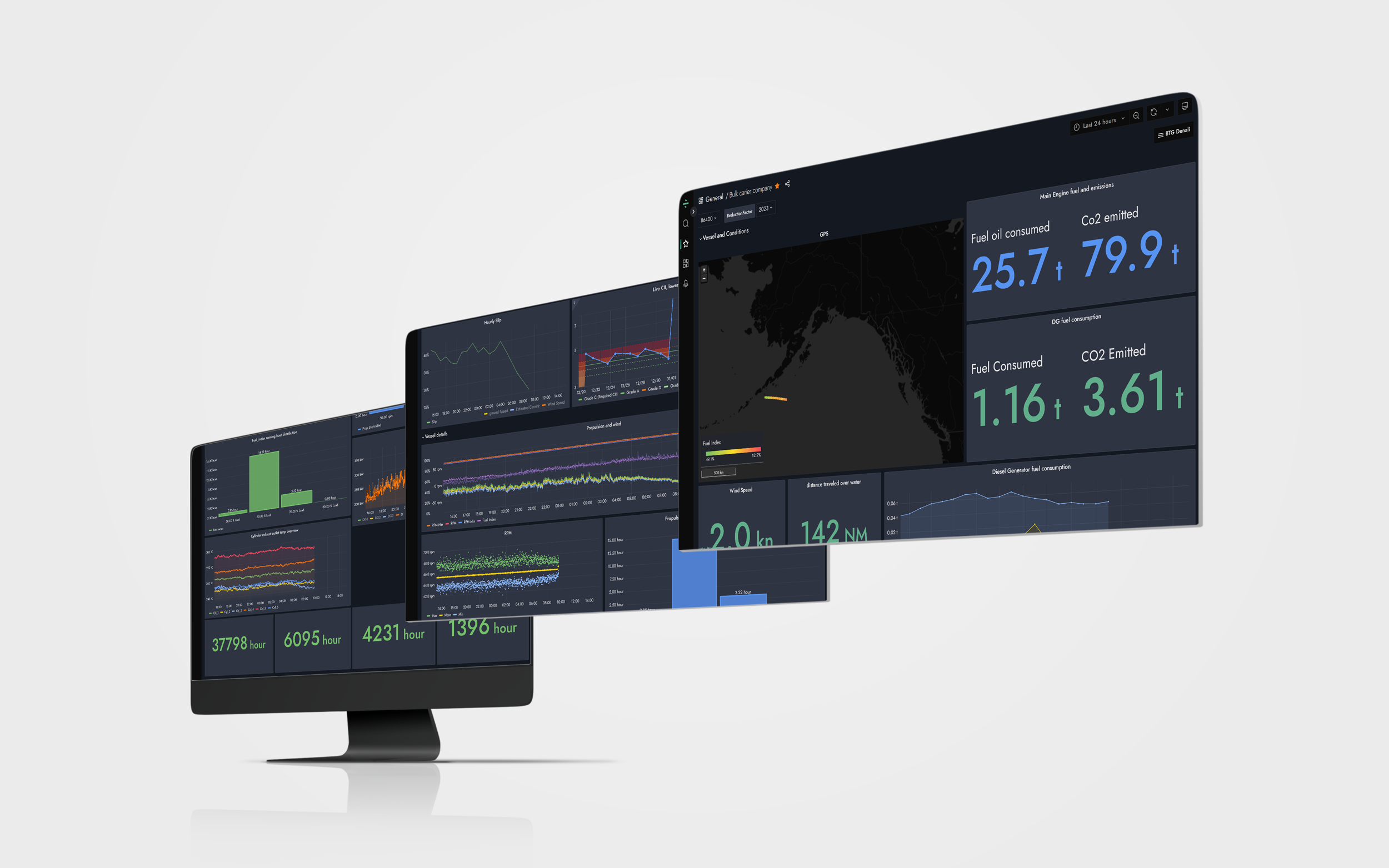
Here at Nortech AI, we have deduced that sensor-based data can be the key facilitator for shipowners to achieve operational excellence in hull performance optimization and engine/power optimization. On top of that, sensor data also enables shipowners to be in full control of their fuel consumption and ultimately their emission profiles, thus improving CII scores. For that reason, together with our clients, we have been working on these issues to deliver the best possible solutions with reliable metrics behind them.
What exactly are we currently working on?
One of our work-in-progress projects is the utilization of sensor data for an 80k DWT bulk carrier built in 2015. For this customer, we are working on establishing and fine-tuning a set of KPIs to measure hull efficiency/management in a simple, actionable format for immediately reducing emissions. This all happens without the need to do a full conversion to another fuel source, and will prolong the longevity of these aging builds while complying with the latest regulations.
The way forward
This article covered different solutions for compliance with the latest regulation, and the potential issues with such solutions. With this article, Nortech AI concludes the article series about the Carbon Intensity Indicator — but Nortech AI is not stopping there. We are continuously working on improving the existing features of our product and developing new tools that will enhance efficiency. In our view, the way forward is to first focus on existing assets and the opportunities to increase operational and technical efficiency. Alternative fuel technologies must develop further before making any bets on the fuel of the future. Nortech AI is your trusted partner on this journey!
Here at Nortech AI we like to be on top of the latest developments in the regulatory environment, but more importantly we can be a trusted partner for shipowners when it comes to digitalization and the further enhancement of decarbonization efforts. Our aim is to facilitate operational excellence based on data-driven decision making.
Sources
- Berrill, P. (2022, October 14). Well-to-wake strategy is vital to stemming emissions — even from carbon-free fuels, says Bureau Veritas. TradeWinds.
- Bureau Veritas. (n.d.). FuelEU Maritime. Marine & Offshore.
- Dixon, G. (2022, November 28). K Line on track to launch ammonia-fuelled newcastlemax in 2026. TradeWinds.
- Dixon, G. (2022, October 27). Pacific Basin opts for methanol on next generation of newbuildings. TradeWinds.
- European Parliament. (2023). FuelEU Maritime — sustainable maritime fuels: legislative train schedule. European Parliament.
- Lindstad, E., Lagemann, B., Rialland, A., Gamlem, G. M., & Valland, A. (2021). Reduction of maritime GHG emissions and the potential role of E-fuels. Transportation Research Part D: Transport and Environment, 101, 103075.
- Priante Martin, E. (2022, December 21). Vale launches contest for methanol-fuelled ore carrier giants loaded with clean tech. TradeWinds.
- Rust, B. (2023, January 20). Hoegh and MAN to go straight to ammonia on four newbuildings. TradeWinds.