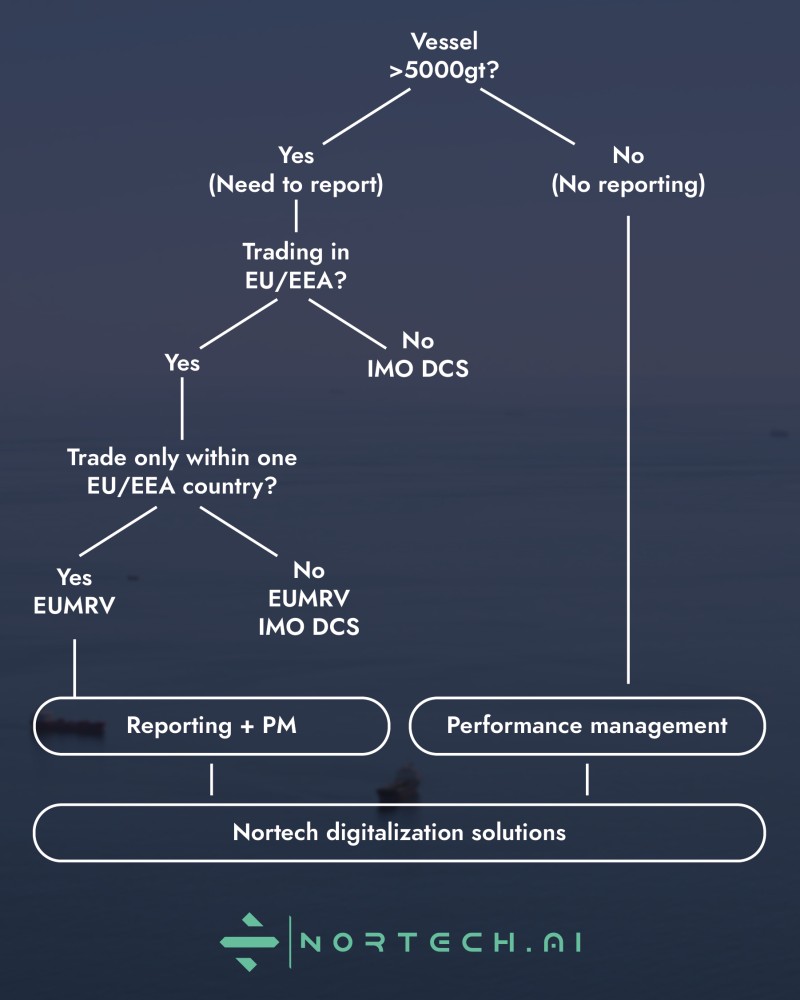
Since 2018, two regulatory frameworks have shaped how vessels monitor and report their fuel consumption and CO₂ emissions: the European Union's Monitoring, Reporting and Verification (MRV) regulation, and the IMO's Data Collection System (DCS). Which one applies — and how you report — depends on a vessel's size and where it trades.
EU MRV — Monitoring, Reporting and Verification (European Union)
In force from 1 January 2018. Applies to vessels over 5,000 gross tonnes that are loading or discharging cargo or passengers at ports in the European Economic Area (EEA), with exemptions for offshore activities, bunkering operations, maintenance and others.
- Monitored on a voyage basis, and then aggregated annually.
- At least one of the two ports of call of the voyage must be located in an EU/EEA territory.
- Only ports where cargo is loaded or unloaded, or where passengers embark or disembark, are counted.
- Departure-from-berth and arrival-at-berth are recorded for every single voyage.
IMO DCS — Data Collection System for fuel oil consumption of ships (IMO)
In force since 1 March 2018. Applies to vessels above 5,000 GT trading internationally, with exemptions for:
- Ships not propelled by mechanical means.
- Platforms, including floating production storage and offloading units (FPSOs), floating storage units (FSUs) and drilling rigs.
- Vessels not engaged in international voyages.
- Vessels granted exemptions by their flag administration.
Under IMO DCS:
- The Ship Energy Efficiency Management Plan (SEEMP) II shall include a description of the methodology used to collect the data.
- At the end of each year the ship must aggregate the data collected.
- There is no need to monitor on a per-voyage basis.
- Report fuel oil consumption according to one of the recognized methods, distance travelled, and hours under way.
The four methods for monitoring fuel consumption
1. Bunker delivery notes (BDNs) with tank readings
IMO DCS — BDNs are used to annualize the total mass of fuel oil consumption; tank readings are done before and after the reporting period.
EU MRV — BDNs are used to calculate the total fuel oil consumption on a voyage basis; tank readings are done periodically (the period being the time between two port calls or the time within a port).
2. Bunker fuel tank monitoring
Fuel tank readings shall be carried out by appropriate methods such as automated systems, soundings and dip tapes.
IMO DCS — Annual fuel oil consumption is determined by the daily fuel oil consumption measured by tank readings, taken daily and each time the vessel is bunkering or de-bunkering.
EU MRV — Daily tank readings, and each time the vessel is bunkering or de-bunkering. The cumulative variations of the fuel tank level between two readings constitute the fuel consumed over the period (time between two port calls or within a port).
3. Direct CO₂ emissions measurement
IMO DCS — Based on CO₂ emission flows in exhaust gas stacks, by multiplying the CO₂ concentration of the exhaust gas with the exhaust gas flow.
EU MRV — On a per-voyage basis, the method determines CO₂ emission flows in exhaust gas stacks (funnels) by multiplying the CO₂ concentration of the exhaust gas with the exhaust gas flow. The fuel consumption is then calculated using the measured CO₂ emissions and the applicable emission factor of the relevant fuels. It must include CO₂ emitted by main engines, auxiliary engines, gas turbines, boilers and inert gas generators.
4. Flow meters
IMO DCS — Fuel oil consumption is annualized from the daily fuel oil consumption data of all relevant fuel-oil-consuming processes on board, measured by flow meters.
EU MRV — Based on measured fuel flows on board. The data from all flow meters linked to relevant CO₂ emission sources is combined to determine all fuel consumption for a specific period (time between two port calls or within a port).
Comparing the methods
- Bunker delivery notes (BDNs) — time consuming, the most manual process, inaccurate for short-term reporting, and can't be used for performance analysis.
- Bunker fuel tank monitoring — time consuming, currently a manual process, and only reports consumption out of the fuel tank.
- Direct CO₂ measurement — costly, difficult to implement, and an indirect fuel consumption measurement.
- Flow meters — exact fuel usage, high-precision CO₂ emissions, efficient, and better control.
Nortech AI is here to help you automate the entire process of reporting and data collection. We facilitate automatic readings of tank level, direct CO₂ measurements, and flow meters. We understand that the manual process of using bunker delivery notes for reporting fuel oil consumption can be burdensome, and we are here to help you make the digital transition.
Additionally, our connectivity solution will help you capture the necessary sensor data for energy performance monitoring, furthering your mission towards ESG compliance. Your journey towards a greener future starts now — Nortech AI is committed to helping you make better data-driven decisions!